
Nov 2, 2010


Oct 29, 2010
upcoming productions
First, a reading of Herbie in Independence, Kansas at the Inge Center Nov 6 at 7:30
Then a reading of Incendiary at Southern Rep in the New Orleans fringe Nov 19, 20, 21
2, maybe 3 productions of Nerve. (They all haven't been announced, so I'll hold off on the specifics.)
Deflowering Waldo in Rochester, NY Opening Feb 5 http://www.staszpruitt.com/
Another show of mine in NYC in Jan.
And some other stuff TBA.
Then a reading of Incendiary at Southern Rep in the New Orleans fringe Nov 19, 20, 21
2, maybe 3 productions of Nerve. (They all haven't been announced, so I'll hold off on the specifics.)
Deflowering Waldo in Rochester, NY Opening Feb 5 http://www.staszpruitt.com/
Another show of mine in NYC in Jan.
And some other stuff TBA.
Square One Series
I'm traveling a lot this year. This is part of the reason why. Am I coming to your town? Maybe. Mark your calendar. Info below:
Bloomington, IN – The Bloomington Playwrights Project (BPP) is proud to announce the inaugural play for the Square One Series, Elsewhere by Adam Szymkowicz. The innovative Square One Series will workshop a new work each year in collaboration with five theaters total.
The Schedule is as follows:
Dec. 6 – reading at Chicago Dramatists, Chicago, IL
Feb. 8 – reading at Greenbrier Valley Theatre, Lewisburg, WV
Mar. 15-16 – reading at Bloomington Playwrights Project, Bloomington, IN
May 27-June 11 – Production at Theatre Conspiracy, Fort Myers, FL
Next Fall – Production at Exposed Productions, New York City
Created by the Bloomington Playwrights Project, the Square One Series is designed to change the game of playwriting workshops and to give small professional theatres a larger role in the national new works scene. The predominant method of “workshopping” is reliant on an artistic department selecting one script out of many and producing a simple reading of the script for an audience. Often times this is accompanied by only 1 day of rehearsal and limited re-writes. In truth, it is less of a workshop and more of a reading series. Depending on the outcome of the reading, the Artistic Director will either choose to produce the script or not. More often than not it is the latter. This leaves the playwright with the same undeveloped script back at square one: sending the scripts out to every theatre possible in hopes of getting yet another “workshop” reading. BPP’s Square One Series aims to remedy that situation through a collaboration of small professional theatres in a progressive development format.
About ELSEWHERE: When Teddy comes to Celia’s house to deliver a package, he doesn’t expect to be invited for dinner. When he comes to dinner, he doesn’t expect to be invited to live with her. When he starts to live with her, he doesn't expect to fall in love with her sister Amanda. And he definitely doesn't expect to be drugged ... or buried alive.
I Interview Playwrights Part 274: Mando Alvarado


Mando Alvarado
Hometown: Pharr-San Juan-Alamo, Texas
Current Town: Brooklyn, NY
Q: Tell me about Cino Nights and the play you did for it with RPR.
A: Cino nights is homage to Joseph Cino and the downtown theater days. We rehearsed for one week, and then put it up for one night. Kind of like a happening. It was an amazing experience. Intense, enlightening, motivating, and really rewarding. That rehearsal week felt like a lifetime, but in a great way. When Daniel commissioned me to write the piece, I knew I wanted to play with structure and narrative. So in late August, I was up for a week at writer's retreat working with Taibi, Sarah, Jen Ferrin and Bernardo. We hammered out a way of working that helped me figure out what I needed to do to make the play come alive. It was a crazy five days. Real honest exchange of ideas, personal demons and self reflection. Back here in NYC, we had the same intense work week. Taibi, my director, and the actors, Bernardo, Jolly, and Sarah were real pro's. They gave a lot to the play and I'm eternally grateful. They dove into the work and really found ways to lift the nuance of the construct of the play. They found beautiful ways to navigate the fluctuating structure of the play which jumps between five realities -Present, Past, Memory, Thoughts in the Memory, In between, and What if.
Q: What else are you working on?
A: I'm currently in workshop rehearsals for La Maga de Oz for Theaterworks USA. It's a latinofied interpretation of The Wizard of Oz. I'm also a participating company playwright for Theater 167's new project about fairy tales. And in rewriting mode for my play Basilica that is being developed for Rattlestick Playwright's Theater. We're planning a workshop production in my home town and then premiering it in NY for their upcoming season. Also working on not going crazy if there's not enough work. AND working on how the hell I'm gonna pay the bills so I can continue my theatrical habit.
Q: Tell me, if you will, a story from your childhood that explains who you are as a writer or as a person.
A: I loved Rocky. When I was a kid, I pretended to be Rocky. My uncles would mess with me, making me go running really early in the morning, making me drink eggs, box, do one arm push ups, run up stadium stairs like the stairs in Rocky. I was a maniac! And I knew they were fucking with me but I didn't care. It gave me permission to play pretend. When I got older and I learned about how the movie came about and why it was written, I found a deeper respect for the work and what Sylvester Stallone did. I guess I wanted to have that same kind of control with my work and find ways to say it my way. I AM ROCKY!
Q: If you could change one thing about theater, what would it be?
A: The role of the critic. I've seen a lot of my friends go through the critical process and it devastates them. I don't really understand how one person has the power to validate the work. Who gave him or her that power? I would like for each critic to write a play, get it on it's feet and then have a room full of Artistic Directors, actors, directors, and playwrights come critique the work. You have to earn the right to be an arbitrator of taste. I know they are a part of the machine. I don't question that. I question their qualifications. You have to be able to do what you judge. That's all I'm sayin!
Q: Who are or were your theatrical heroes?
A: Luis Valdez, Clifford Odets, Harold Clurman, August Wilson, Lewis J Stadlen - gave me the balls to call myself a professional, Robert Beseda, Jackyln Maddux, Gerald Freedman, Michael Lluberes, Stephan Adly Guirgis, David Mamet, Migdalia Cruz, Craig Wright, Wolly Mammoth Theater Company, Gregg Henry, Michael Ray Escamilla, Those Guys, Michael John Garces, Jorge Cortinas, Raul Castillo, The incomparable Felix Solis, Ed Vassalo, Alex Correia, Jeremy Skidmore, Abs, Rene Garza, Wayne Adams, Peter Hedges, my classmates from NCSA, the Tex Mex Mafia, Lou and INTAR, and as far as people that really challenge me as a writer and shaped how I approach the work, I got to say these three people really cracked the prose in my head. Eduardo Machado, really made me challenge my self and what I want to say in my work. David Van Asselt, he gave me a chance, gave me blind faith in a world where product is valued over substance, and Lue Douthit from OSF. She's the Lit. Manager there and she gave me the bones. She opened up the confidence to finally allow myself to feel like a writer. And the one that allowed me to be a writer, Sarena Kennedy!
Q: What kind of theater excites you?
A: Honest, risky, take me on a journey, emotionally challenges me, makes me forget about the day, makes me feel like a kid sitting on the mat ready for story time, other worldly, dangerous, raw, unconventional, nontraditional, (and this if for Alfredo) NON-ALL AMERICAN THEATER in the traditional uninviting sense.
Q: What advice do you have for playwrights just starting out?
A: Learn the rules. rewrite! and rewrite! Don't cheat yourself. Don't be afraid to fail. Screw them if they can't take a joke and never never stop learning. It doesn't get any easier but it does get better. Writing a play is fucking hard and writing a good play is fucking harder. And if you want to make money, learn how to write for TV. There's no money in theater but there's a type of currency that will carry you through the bad times. And say something in the work! And love the one's your with, drink, fight, be honest, give, and don't forget to smile, it's only a play.
Oct 27, 2010
I Interview Playwrights Part 273: Adam Rapp
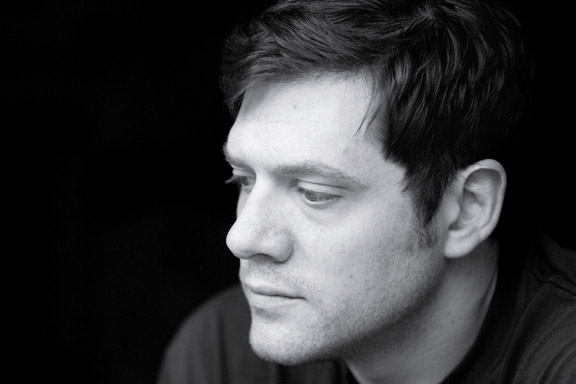
Adam Rapp
Hometown: Joliet. Illinois
Current Town: New York City
Q: Tell me about Ghosts in the Cottonwoods.
A: It’s a play I wrote fifteen years ago. My first full-length. I had no idea what I was doing. It was written on impulse, kind of out of the dark. It was overwrought, overblown with too much self-consciously poetic dialogue, but something about the play has haunted me and I knew I would return to it. Some months ago I pulled it out, looked at it closely, and re-worked it. It seemed like a really good fit for the Amoralists, their style, their mission. I didn’t care for early productions of the play, but mostly I didn’t care for the play. I’m incredibly excited to have this new experience with it. The company is incredibly brave. They kill me every day in rehearsal. Some of the best actors I’ve ever worked with. I’m having a blast. The play is about a single mother and her 20-year-old son who are awaiting the arrival of the older son, who has broken out of prison. They live in a homemade house that is sliding down a hill in a nowhere forested region in the southern Midwest, somewhere between the interstate and the factory outlets. They’ve created their own government of language and their own brutal codes of morality. A stranger shows up, as does the younger son’s girlfriend. And all hell breaks loose.
Q: This isn't the first time you've directed your own work. What do you learn about your plays by directing them?
A: Well, I love directing – all facets of it. But I particularly love working with actors. My plays get better when I direct them because I become a rigorous dramaturg and I care that the audience is involved in every moment. I think the rehearsal process has become an incredibly fertile rewriting and discovery process that I wouldn’t experience if I was simply the defensive playwright in the room protecting his play. I’m not precious with my words or moments. I’m all about finding what works. I try to have fun. I demand a lot from my actors, and they demand a lot from me and I love that these are the stakes.
Q: What else are you working on?
A: I’m rewriting a novel called THE CHILDREN AND THE WOLVES for Candlewick Press, and I’m preparing for my Hallway Trilogy, which starts rehearsals after the new year.
Q: Tell me, if you will, a story from your childhood that explains who you are as a writer or as a person.
A: I was raised Catholic. In church I used to daydream. I would fall in love with one girl during mass. I would imagine our lives together, our kids, the car in the garage, tornadoes, cows flying through the air, getting shipped off to war, getting my leg cut off, being chased by the FBI. Church was where I started making things up, started living in my head. For me, I think that’s where the impulse to write started.
Q: If you could change one thing about theater, what would it be?
A: Government legislated 20-dollar tickets. Including Broadway.
Q: Who are or were your theatrical heroes?
A: Caryl Churchill, Pinter, John Guare, Edward Bond, Chekhov, Genet, Beckett, Irene Fornes, David Rabe.
Q: What kind of theater excites you?
A: The kind in which I am surprised by deft hard actions, the kind that trusts ambiguity and mystery, the kind that haunts and disturbs me. I hate leaving a play feeling resolved and entertained. I want to be shaken by something. I want to be made to forget that I was actually in a theater.
Q: What advice do you have for playwrights just starting out?
A: Don’t wait for someone’s stamp of approval. Start making work in your living room. Waiting is death. Figure out how to make something work in a room with a window and a door. Maybe add a phone.
Q: Plugs, please:
A: “Gatz” by Elevator Repair Service is incredible. The National’s record “High Violet.” Café Mogador on St. Mark’s Place.
Oct 25, 2010
I Interview Playwrights Part 272: Eliza Clark

Eliza Clark
Hometown: Darien, CT
Current Town: Culver City, CA
Q: Tell me about Edgewise.
A: EDGEWISE is a dark, comedic thriller about three teenagers flipping burgers during a near future total war. It’s about what people are capable of under extreme circumstances and what happens in a world operated by fear. I hope, too, that it will be a fun ride, that you’ll be laughing and enjoying yourself in spite of (or maybe even because of) some of the more brutal elements of the play. It’s an exploration of what life would be like for Americans living in an American war zone, specifically New Jersey.
Q: What else are you working on?
A: I moved to LA a year ago to write for a new AMC show called Rubicon. The final episode of the season just aired and so right now we’re sitting tight, crossing our fingers for a second season. In the meantime, I’m working on a pilot about teenagers working at a Walmart-type superstore. I have a thing for kids working shitty jobs. One of my favorite directors and collaborators, Lila Neugebauer, is directing a 30 minute play of mine called SNOW DAY that goes up for a couple nights the week that Edgewise closes. I’m pretty excited about that! I’ve also been working all year on a play called DEAD CHILDREN about a family living in a town that’s being terrorized by a serial killer.
Q: Tell me, if you will, a story from your childhood that explains who you are as a writer or as a person.
A: When I was six years old, I was in a wonderful musical called Opal, written by Robert Lindsey-Nassif, that went up at the Lamb’s Theatre. It was based on the diary of a six-year-old French orphan, the sole survivor of a shipwreck taken in by a woman in a lumber camp, at the turn of the 20th century. It’s a really sweet, sad, wonderful musical with a beautiful, haunting score.
I loved being in the show – and I was in almost every scene (a situation that lead to me peeing my pants on the stage no less than twice). During the run, I started writing in my diary in Opal’s writing style, which was a sort of French to English translation – she would write sentences like, “I did go to the store” or “I did wake up.” I basically unlearned English in order to write in the style of a girl I wanted to be (‘cause she was published!). At one point, I wrote letters to myself from God and hid them backstage for the rest of the cast to find. Throughout the run, the other actors would find notes on the set written in six-year-old scrawl that said things like, “Dear Eliza, Break a Leg, Love, God.”
Not exactly sure how it relates to me becoming a writer, but I had an active, delusional imagination, I guess, probably from growing up in theaters. I don’t know what I was like as an actor, really, but I know that I had already started thinking of myself as a writer by age six.
Q: If you could change one thing about theater, what would it be?
A: I wish there were more women whose plays were being produced. I wish that audiences would be more excited about seeing “science fiction” on stage. I’m told sometimes that I write sci-fi plays and that can be a bit of a turn-off. I love science fiction (though I don’t really think I would categorize what I do as sci-fi). But once people started saying that about my work, it got me thinking that I’d actually really love to write a straight up science fiction play. I would dig seeing something like that on stage. Ender’s Game, for instance, could be a beautiful night of theater.
I have this dream of owning a theater. It should be stated that in my fantasy, money is no object. I want to start a theater in Los Angeles, where there are a couple of fantastic theaters, but in general, the scene is rather small (certainly not as vibrant and overflowing as New York theater). I don’t want subscribers. I don’t want to have to do anything other than exactly the kind of theater that I would want to see. Again, money is no object, so if two people come to the show, then so be it. So we would only pick shows we love, shows by playwrights who don’t have agents or plays that nobody else wants to produce, or plays that everybody wants to produce but only with some crazy movie star in the starring role instead of the crazy talented weirdo theater actor who is really right for the part.
I guess it’s a childish fantasy, in that the dream is basically just, “I want a theater where I get to do whatever I want to do.” But it’s my fantasy, so it can be as silly as I want.
Q: Who are or were your theatrical heroes?
A: There are too many. Here are a few. Deb Margolin, a writer/solo performer/teacher/mentor/goddess who helped me tap into some really messed up part of me that has never really gone away. Deb’s writing soars, it’s really quite amazing. Martin McDonagh – The Pillowman is the play that I most often give to people – it’s my favorite. Liz Meriwether, Amy Herzog, and Annie Baker – a real triumvirate of fantastic female playwrights who I think are killer writers as well as some of the nicest people around. The playwrights I’ve worked with in Youngblood (EST’s writing group for emerging playwrights under thirty) and Interstate 73 (Page 73’s writing group). I’ve been really blessed to be a part of supportive communities filled with writers I admire and learn from.
Q: What kind of theater excites you?
A: Theater that is visceral, that elicits a physical reaction. I like laughing until I feel like I’m going to puke. I love musicals – that soaring, skipping feeling you get listening to someone belt out a song. When I saw Blasted at SoHo Rep, I felt a sheer terror that I had never felt in a theater before. A movie can get you up close to the action, can make everything insanely realistic, but nothing but live theater can make you feel like you’re right there, like you might be in danger. I live for that feeling.
I like theater that entertains. I have a low-brow sensibility that would totally appreciate seeing Die Hard on the stage. I like being frightened. I like when theater calls me out for the way I live my life.
Q: What advice do you have for playwrights just starting out?
A: I’m just starting out! I guess my advice would be to keep writing. Donald Margulies, who was a professor and mentor of mine in college, always encouraged me to just move on to the next play instead of spending months and months editing. I sometimes thought it meant that he didn’t like my play, but I realize now that he knew the secret of becoming a better writer, which is just to write and write and write. I try not to get too attached to or precious about my work. Actors and directors are great at cutting right to the heart of something, and it’s so important to listen to smart people you trust when they are saying, “Cut these pages, cut this scene, etc.” Just make sure you like their sensibility. I’ve been lucky to work with people I really admire and click with. Find those people and then let them go to town.
Q: Plugs, please:
A:
EDGEWISE
DIRECTED BY TRIP CULLMAN
presented by Page 73 and The Play Company
NOV. 9 – DEC. 4, 2010
@ Walkerspace (46 Walker Street)
Tickets:
Online at https://www.ovationtix.com/trs/dept/255
Or call (212) 352-3101
More information here: http://www.p73.org/programs/productions/edgewise/
SNOW DAY
DIRECTED BY LILA NEUGEBAUER
(part of)
DIRECTORFEST 2010
Four 30-minute plays, directed by the 2010 Drama League Fall Fellows.
The Barrow Group Theater - 312 West 36th Street 3rd Floor
For tickets, call 212-244-9494 or email kcarter at dramaleague.org
Thursday, December 9 · 8pm
Friday, December 10 · 8pm
Saturday, December 11 · 2pm
Saturday, December 11 · 8pm
Sunday, December 12 · 3pm More information here: http://dramaleague.org/?page_id=2627
Subscribe to:
Comments (Atom)